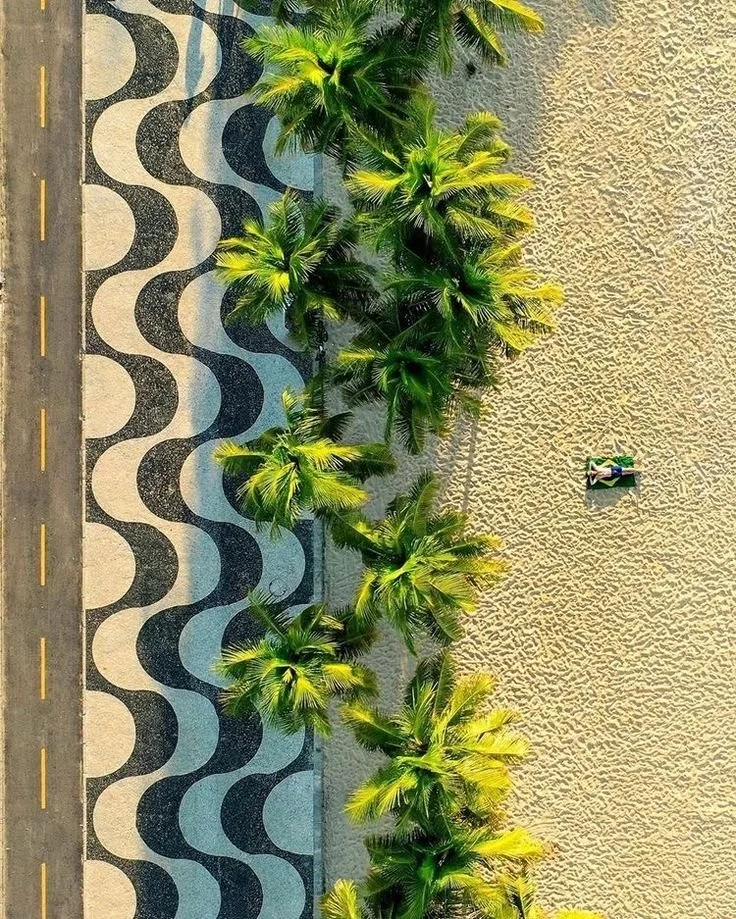
In Brazil, modernism grew out of landscape, material and a complex cultural history - shaped by a distinct sense of place.
In many countries, architecture, landscape and furniture evolved as separate disciplines. In Brazil they often appear as parts of the same conversation - shaping environments that feel both modern and deeply connected to place.
This quality is particularly visible in the mid-twentieth century, when Brazilian designers reinterpreted European modernism through the lens of their own landscape, materials and way of life.
Where the European avant-garde often pursued strict functionalism, Brazilian designers introduced a different sensibility: one that allowed modernism to breathe.
Architecture offers the clearest expression. The sweeping concrete forms of Oscar Niemeyer, for example, rarely feel rigid or mechanical; instead, they flow with a sculptural ease that echoes the contours of the landscape. Around these structures, Roberto Burle Marx developed gardens that were equally modern yet profoundly rooted in Brazilian flora and geography.
Together they created environments in which architecture and landscape became inseparable.
Furniture evolved within this same dialogue. Designers such as Joaquim Tenreiro and Jorge Zalszupin produced works that feel simultaneously modern and organic - refined structures that celebrate the beauty of Brazilian hardwoods such as jacaranda and pau ferro.
In these pieces, the material is never secondary. The warmth of the timber, the rhythm of the grain and the lightness of the structure all contribute to a sense of quiet vitality.
Perhaps this is what distinguishes Brazilian modernism most clearly. It retains the intellectual clarity of modern design, but tempers it with warmth, informality and an unmistakable relationship with nature.
Spaces are rarely rigid. Interiors flow easily toward gardens and terraces, reflecting a climate and culture in which life is lived both indoors and out.
The result is a form of modernism that feels unusually humane.
In many countries, architecture, landscape and furniture evolved as separate disciplines. In Brazil they often appear as parts of the same conversation - shaping environments that feel both modern and deeply connected to place.
This quality is particularly visible in the mid-twentieth century, when Brazilian designers reinterpreted European modernism through the lens of their own landscape, materials and way of life.
Even today, this spirit continues to shape contemporary Brazilian architecture and design. The work of architects such as Marcio Kogan and Isay Weinfeld demonstrates how modern structures can remain expressive, tactile and deeply connected to their surroundings.
Brazilian design reminds us that modernism was never a single language. In Brazil it became something distinct: a synthesis of modern thought, natural materials and cultural confidence.
Modern - but never detached from life.