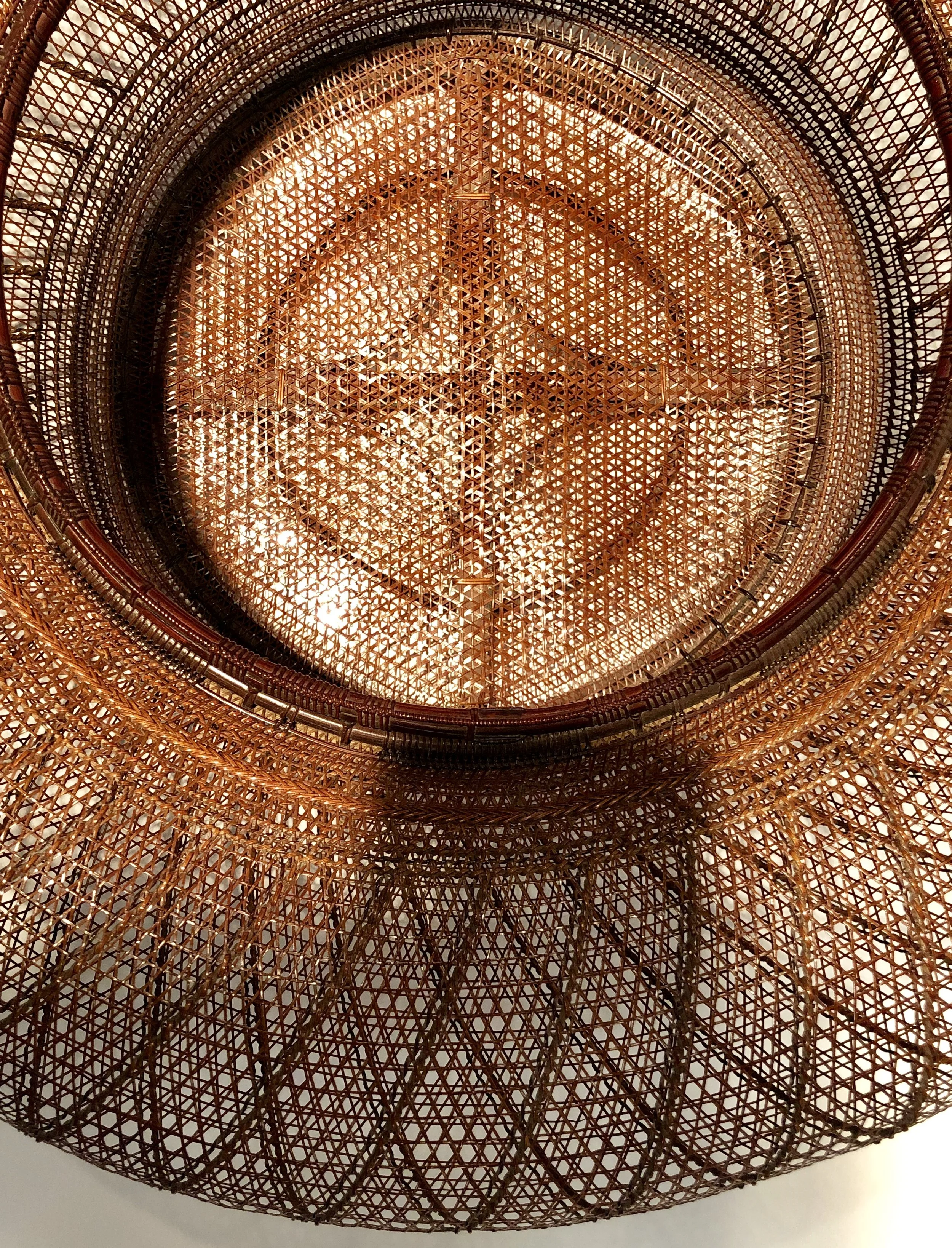
Some objects command attention through complexity. Others do so through something quieter: the intelligence of their material.
In the most enduring examples of design, the maker does not impose form onto matter. Instead, they recognise what the material already wants to become.
When this happens, design begins to feel inevitable.
Japanese bamboo basketry offers a clear example. A length of bamboo is strong, flexible and resilient. Split into fine strands, it becomes capable of extraordinary tension and delicacy. The resulting baskets - particularly the flower vessels known as hanakago - are not simply containers, but structures that seem to grow naturally from the material itself. The curve of the rim, the lattice of the weave, the quiet asymmetry: each emerges from bamboo’s inherent properties rather than decorative intention.
The same principle can be found in Murano glass.
For centuries, Venetian glassmakers have understood that molten glass is both fluid and architectural. It gathers, stretches, folds and captures light in ways few other materials can. The most compelling Murano pieces do not fight this behaviour - they allow it to define the object. Colour becomes suspended within mass, edges soften into luminous contours, and the object seems to hold light within its form.
In both cases, the maker’s role is not domination, but guidance. This is perhaps why such works feel so composed. The design is not layered onto the material; it emerges through it.
Many of the most admired objects in design history follow this same principle. The curve of bentwood in Thonet chairs. The quiet mass of carved stone in Japanese gardens. The weight and density of a well-cut block of crystal. In each case, the material carries much of the work.
When material and form are aligned, decoration becomes unnecessary.
The object achieves something rarer: presence.