Design history often associates value with weight - but why?
Dense materials - stone, hardwood, bronze, crystal - convey permanence. Their mass anchors them in space and signals durability. It is one reason why heavy objects often feel authoritative. Yet some of the most compelling objects in design possess the opposite quality: they are light.
Lightness in design is a peculiar thing.
Objects that weigh very little tend to be perceived in one of two starkly contrasting ways. They either feel cheap and disposable, or they feel remarkably refined. Rarely are they anything in between.
The distinction lies not in the weight itself, but in how that lightness is resolved.
When structure is thoughtful and precise, light materials can produce extraordinary elegance. Japanese bamboo basketry offers a clear example. Split into thin strands, bamboo becomes both flexible and resilient, allowing makers to create vessels whose delicacy belies their structural strength. The resulting forms appear almost weightless, yet remain remarkably durable.
Modern design explored this principle further as new manufacturing techniques emerged. Bentwood furniture, tubular steel chairs and thin moulded plywood all sought to reduce mass while preserving strength. Designers discovered that carefully distributed structure could achieve stability with surprisingly little material.
The Noguchi paper lantern offers another example. Made from little more than paper, wire and bamboo, it produces a luminous presence that feels both fragile and complete. Its beauty lies precisely in how little is required to achieve the form.
Occasionally, lightness becomes something more theatrical.
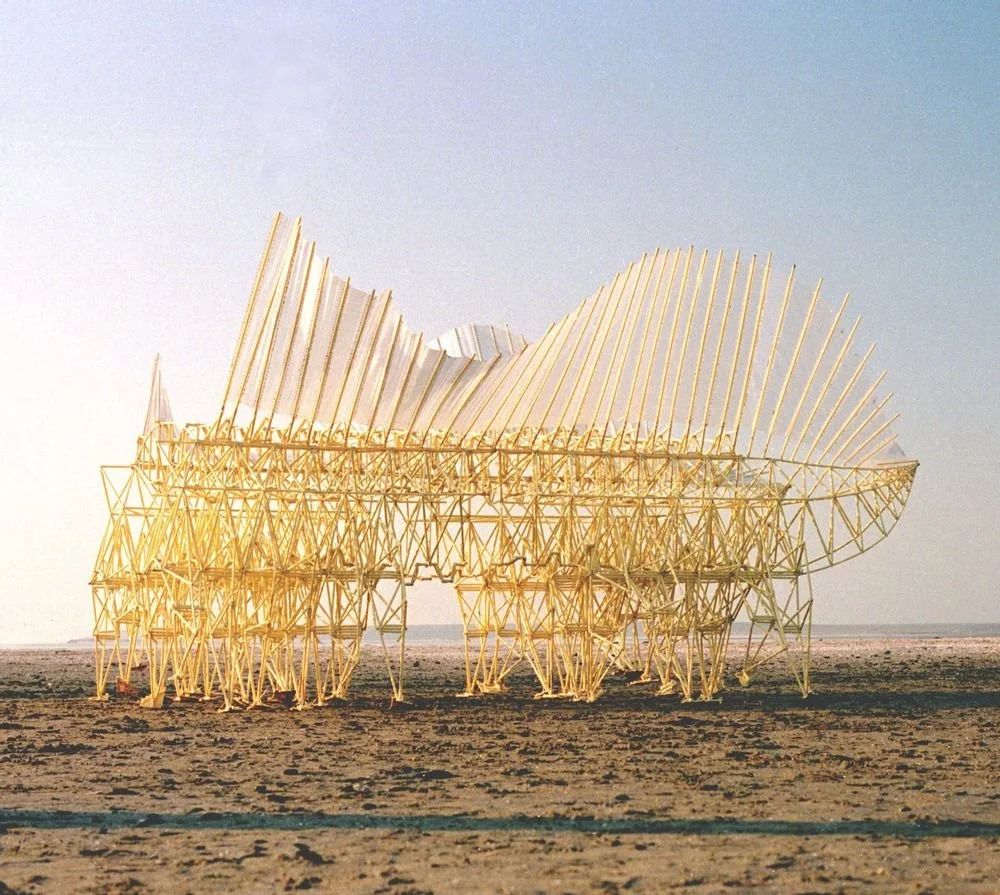
The Dutch artist Theo Jansen’s Strandbeests - vast wind-powered walking structures made from plastic tubing - appear almost skeletal in their construction. Yet when the wind moves them across the beach, they acquire an uncanny sense of life. Their scale suggests weight, but their structure is built from lightness and air.
In these moments, material seems to dissolve into motion.
Perhaps this is why refined lightness can feel so extraordinary. It demonstrates a different kind of intelligence - one that relies not on mass, but on understanding exactly how little is necessary.
When structure is resolved with care, lightness does not diminish an object.
It reveals the discipline behind it.